

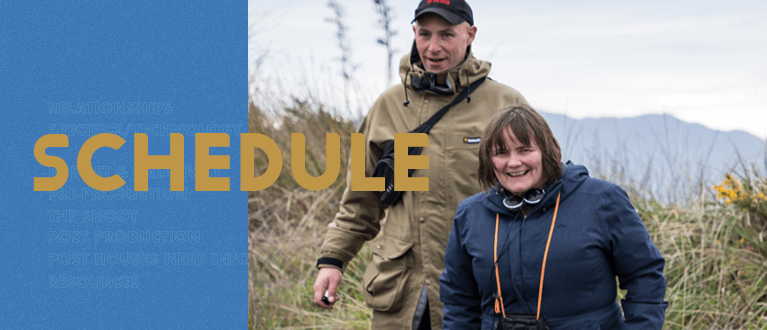
Schedule
Talk schedule – you’ll need to know when media comes in and when it goes out and what you need in order to make that happen.
Producer and Editor together can decide on a schedule for creativity and budget –
A good producer will know that creativity will result in a marketable film with edge.
A good editor will know that delivering on time will ensure the best festivals and markets.
So together you need to thrash out the compromise that makes a great film, which avoids interest rates and pays back its funders.
Screening Deadlines
Assembly, Director’s edit 1, Director’s edit 2, Producers, Funders, Test, Lock. Sounds simple eh? Then there’s the experimental cuts, and the things you’d better try while you’ve got the chance… and the bits that just don’t work…
A L L O W T I M E.
Timelines
So what does an overall production timeline look like?
For Short Films – all the same steps as a cinema feature.
Editor Timeline – Short Films (PDF 81KB)
For Tall Films – all the same steps as a cinema short – just takes longer…
Editor Timeline – Features (PDF 91KB)
Etiquette
Producers – remember it goes faster if only two voices are in the edit (Director and Editor) until the cut is ready for you. Your fresh eyes at that stage are a crucial asset and will speed up the edit. Keep your eyes fresh.
Page last updated on 23 August 2022
Top Image: DOP Matt Henley and producer Catherine Fitzgerald on location of Coming Home In the Dark (Courtesy of Blueskin Films Ltd)
© Directors and Editors Guild of Aotearoa New Zealand 2022. We grant permission to reproduce the content in this guide for personal and educational use only. Commercial copying is prohibited. We retain the right to be identified as the author of this work; please credit ‘Directors and Editors Guild of Aotearoa New Zealand’ whenever quoting from or reproducing this guide.